GaMe: Geometry as Memory for Multi-View Spatial Reasoning

Xiaoshan Wu, Xiaoyang Lyu, Yifei Yu, Muxin Liu, S. Shi, Zhongrui Wang, Xiaojuan Qi

Under review · ICRA 2027

TL;DRA compact geometric memory combines evidence across views and augments the original visual–language context for spatial question answering.

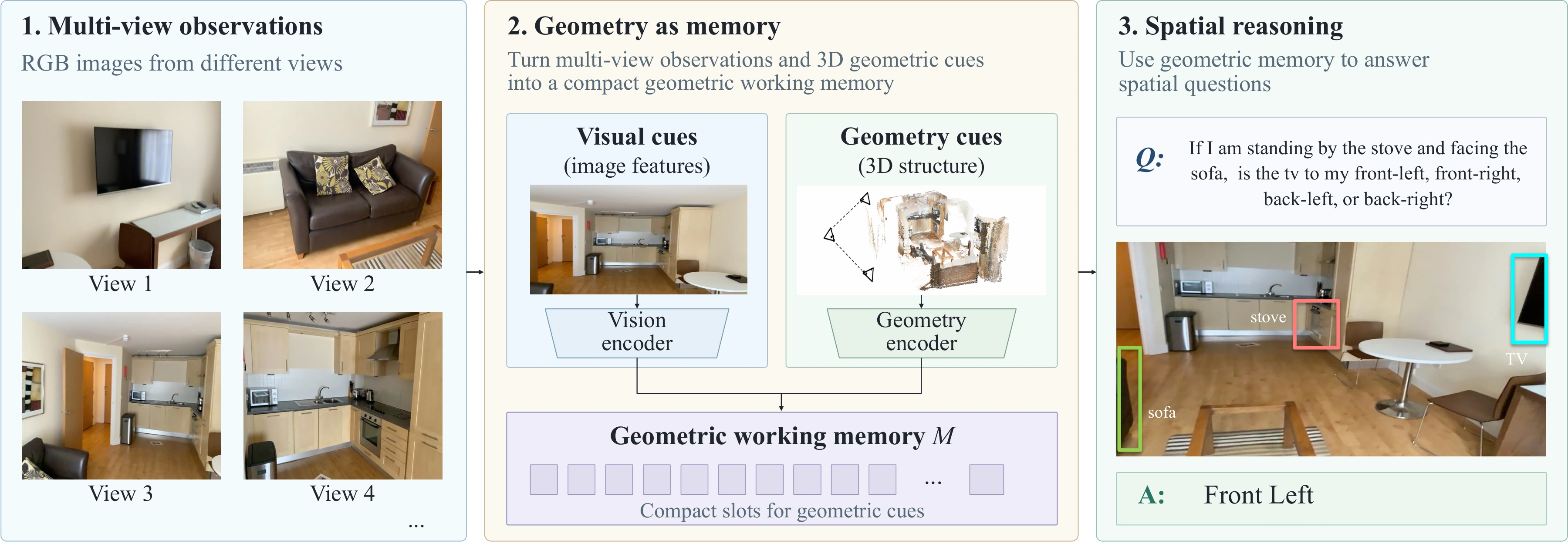
Conceptual project overview from the original manuscript figure. The scenes, point cloud and example answer illustrate the approach; they are not evaluated predictions.
Conceptual project overview from the original manuscript figure. The scenes, point cloud and example answer illustrate the approach; they are not evaluated predictions. Original PDF ↗

Overview

GaMe investigates geometry as a working memory for multi-view spatial reasoning. Rather than replacing the original visual–language context, a 16-slot memory gathers geometric evidence across views and supplies an additional source of spatial context.

Method

Multiple views. A shared spatial context.

01

Gather evidence

Combine visual and geometric information across views.

02

Form a memory

Condense the evidence into 16 working-memory slots.

03

Augment reasoning

Keep the original visual–language context alongside the memory.
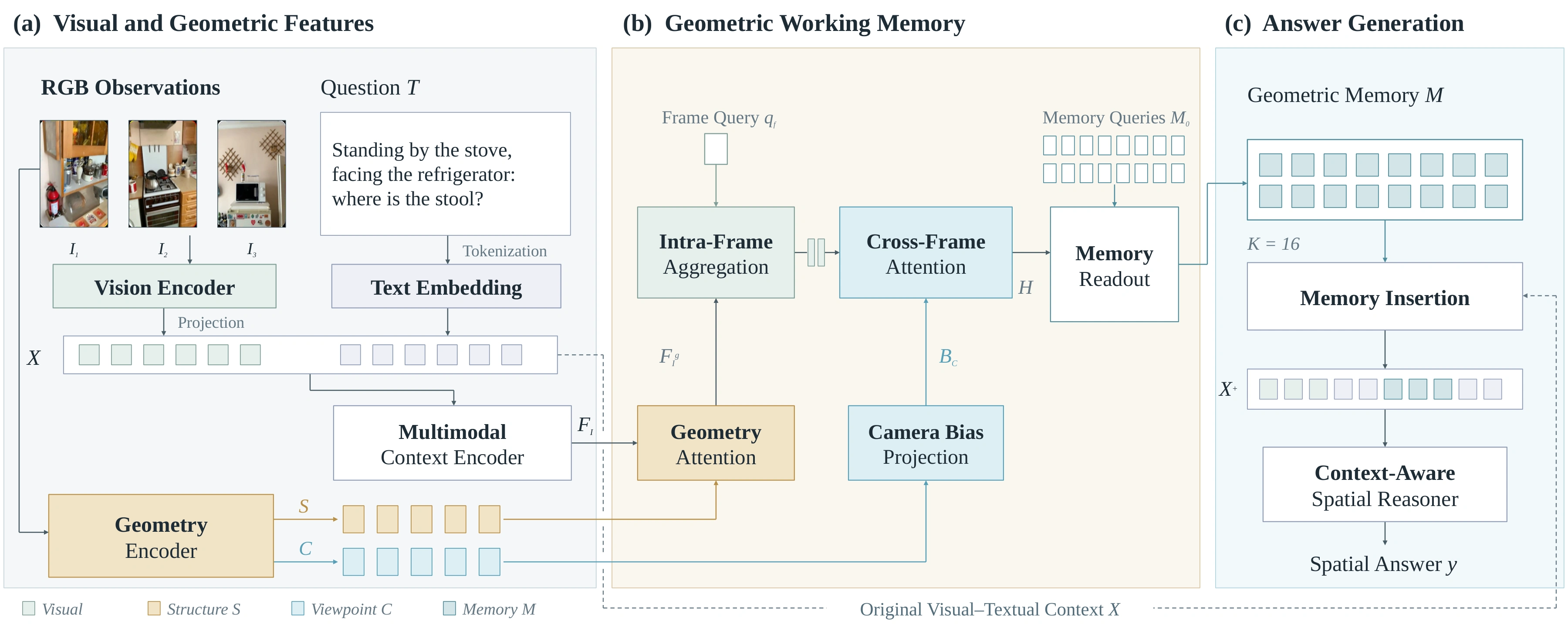
Original method diagram: visual and geometric features, geometric working memory, and answer generation.
Original method diagram: visual and geometric features, geometric working memory, and answer generation. Original PDF ↗

Resources

This page currently presents the project overview. A public manuscript and evaluated examples have not been posted here.